Tag

Collaborations

International collaboration strengthens global disease surveillance News

International collaboration strengthens global disease surveillance

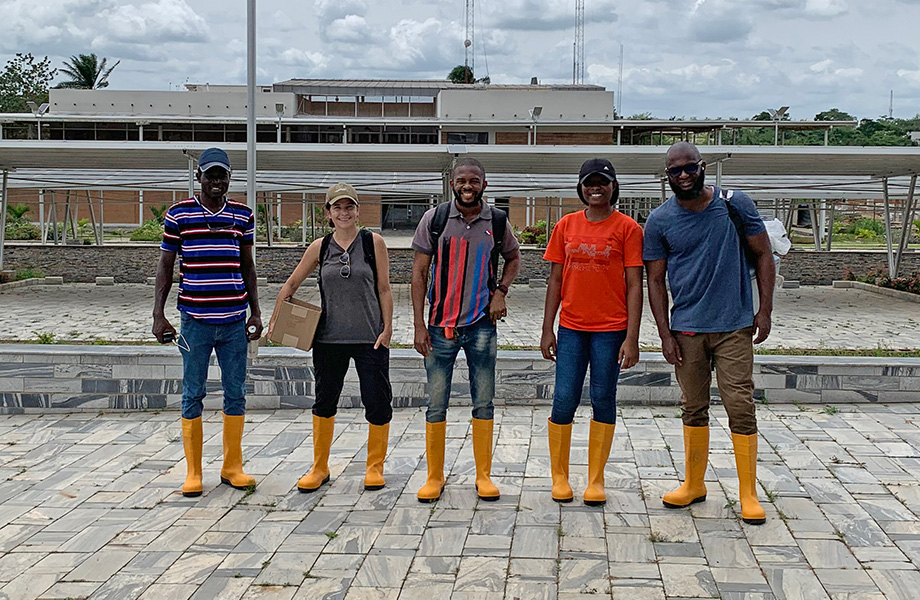
Increasingly researchers have used wastewater surveillance as an effective tool to find out what viruses and which strains of viruses—for example, SARS-CoV-2 variants—are circulating within a community. Providing real-time insights into which diseases might be on the rise helps public health officials to detect and contain outbreaks before they become global pandemics. In late Spring 2023, Scripps Research postdoctoral associates…
August 11, 2023
Two new papers demonstrate use of Outbreak.info as one-stop online source for COVID data Outbreak.info featurePress ReleasesPublications

Two new papers demonstrate use of Outbreak.info as one-stop online source for COVID data

While COVID-19 may be transitioning from a “pandemic” to an “endemic” phase, it remains critically important to continue tracking the virus in real-time. In two new papers published in Nature Methods on Feb. 23, 2023, scientists at Scripps Research demonstrate the use of Outbreak.info as a standardized, searchable source of information on the COVID-19 virus and its many variants. Since the COVID-19 pandemic began,…
February 23, 2023
WARN-ID Genomic Epidemiology Training Lays Groundwork for Future Research trainingTraining

WARN-ID Genomic Epidemiology Training Lays Groundwork for Future Research

WARN-ID recently concluded a six-week genomic epidemiology training of  44 trainees across seven countries. The training was composed of three modules aimed at meeting the immediate need for SARS-CoV-2 sequencing, while also providing a vital foundation in genomics and bioinformatics for future development.  26 pre-recorded lecture videos, didactic sessions, office hours, supplemental materials, and ongoing support through a dedicated Slack…
October 3, 2022
SARS-CoV-2 studies from the Middle East out in Nature Comms SARS-CoV-2Press ReleasesPublications

SARS-CoV-2 studies from the Middle East out in Nature Comms

Understanding the global transmission of SARS-CoV-2 is critical for rapidly containing and handling the virus, especially as new variants and mutations of concern emerge. Certain regions in the world, including the Middle East and Northern Africa region, have been notoriously understudied and under-sampled. For the first time, Scripps Research scientists and collaborators unveil how the virus spreads in this region…
September 3, 2022
SARS-CoV-2 ‘origin’ studies out in Science SARS-CoV-2Press ReleasesPublications

SARS-CoV-2 ‘origin’ studies out in Science

The COVID-19-causing coronavirus, SARS-CoV-2, likely first spread to humans from animals in two separate transmission events in a Wuhan market in late November 2019, according to a pair of analyses by international teams co-led by Scripps Research scientists. The analyses, published July 26, 2022 in Science and released in earlier, pre-print versions in February, were based mainly on the locations of cases…
July 29, 2022
SARS-CoV-2 surveillance study out in Nature SARS2 surveillancePress ReleasesPublications

SARS-CoV-2 surveillance study out in Nature

It can be a bit smellier than other ways of monitoring COVID-19, but analyzing wastewater is a cheaper, faster and more accurate way for public health officials and researchers to detect rising cases. Bits and pieces of the SARS-CoV-2 virus are flushed down toilets and washed down sinks by infected individuals; more copies of the virus found in sewage means…
July 13, 2022
Ebola relapse study out in NEJM Congo RiverPublications

Ebola relapse study out in NEJM

Our study investigating a rare case of Ebola relapse has been published in the New England Journal of Medicine. Together with our colleagues at INDR in the Democratic Republic of Congo, the University of Nebraska Medical Center in Omaha, and several other institutions, we investigated a case of a vaccinated man who had already been sick with Ebola fell ill with…
April 9, 2021
Study on B.1.1.7 out in Cell graphical abstractPublications

Study on B.1.1.7 out in Cell

Our study investigating the spread of the B.1.1.7 SARS-CoV-2 variant first discovered in the UK has been published in the journal Cell. Together with our colleagues at the San Diego-based company Helix, we used testing data, genomics, and modeling to answer two simple questions - when was B.1.1.7 introduced into the US and how is it currently spreading in this country?…
April 9, 2021